Buying an app with seller financing: a practical path to ownership
Learn how seller financing, purchase options and sweat equity can support an app acquisition, with profit-sharing examples and repayment checks.

Research method
A documentation-based explainer checked on October 9, 2026 using Acquire.com, McCormick Law & Consulting, CFI, Yale School of Management, an example purchase-option clause and Apple Developer documentation. All deal terms and calculations are hypothetical. No acquisition was executed or seller offer verified for this article. Images are AI-generated editorial illustrations.
You can have the skills to improve an app without having the cash to buy it. Seller financing can bridge that gap: the owner accepts some or all of the purchase price over time. Another starting point is to operate the app under a performance agreement, with a right to buy it later on terms agreed before you begin.
Both approaches need an owner willing to accept the arrangement, a business that can support it, and clear responsibilities when performance disappoints. The useful question is how much cash the app can distribute while someone keeps it running.
TL;DR
| Your question | Practical answer |
|---|---|
| What is this called? | Entrepreneurship through acquisition, using seller financing, a purchase option or an equity earn-in. |
| Can you start without the purchase price in cash? | Possibly, if the seller accepts deferred payment. Operating costs, transaction expenses and your living costs still need funding. |
| Does a profit share give you ownership? | No. Compensation, purchase credits and equity are separate rights. |
| What happens if earnings fall? | A seller-financed debt can remain due. An earnout makes a defined part of the price conditional on results. |
| What should be agreed first? | The profit definition, operating authority, purchase terms, payment obligations and exit arrangements. |
This is a researched explainer with hypothetical examples, checked on October 9, 2026. It does not describe a completed NaviStack acquisition or a financing offer. Images are AI-generated editorial illustrations. Have a transaction lawyer and accountant review the structure for the parties and jurisdictions involved.
What seller financing means when you buy an app
In a seller-financed acquisition, the seller becomes a creditor for the unpaid purchase price. The buyer takes ownership at the agreed closing and pays under the financing agreement. The debt is often documented in a seller note, also called a promissory note. Vendor financing is another name for this arrangement.
For example, a hypothetical $20,000 purchase might involve $5,000 at closing and a $15,000 seller note. The note sets the interest, payment schedule and maturity date, alongside any security or guarantees. Full seller financing would defer the entire purchase price, but the seller must agree to take that additional exposure. Acquire.com's guide to deal structures
Buying and operating an existing business falls under entrepreneurship through acquisition, or ETA. A search fund is one investor-backed model within that field; it isn't a requirement for a small app deal. Yale's explanation of ETA and search funds
Start by identifying what you would own. An app sale might transfer a store listing, code, domain and backend as selected assets. Buying shares in the seller's company is a different transaction. The phrase “buy the app” is too imprecise for an agreement, especially when the seller uses shared infrastructure across several products. Our app acquisition due diligence guide covers the evidence to request before negotiating a firm price.
Seller financing, earnouts and sweat equity solve different problems
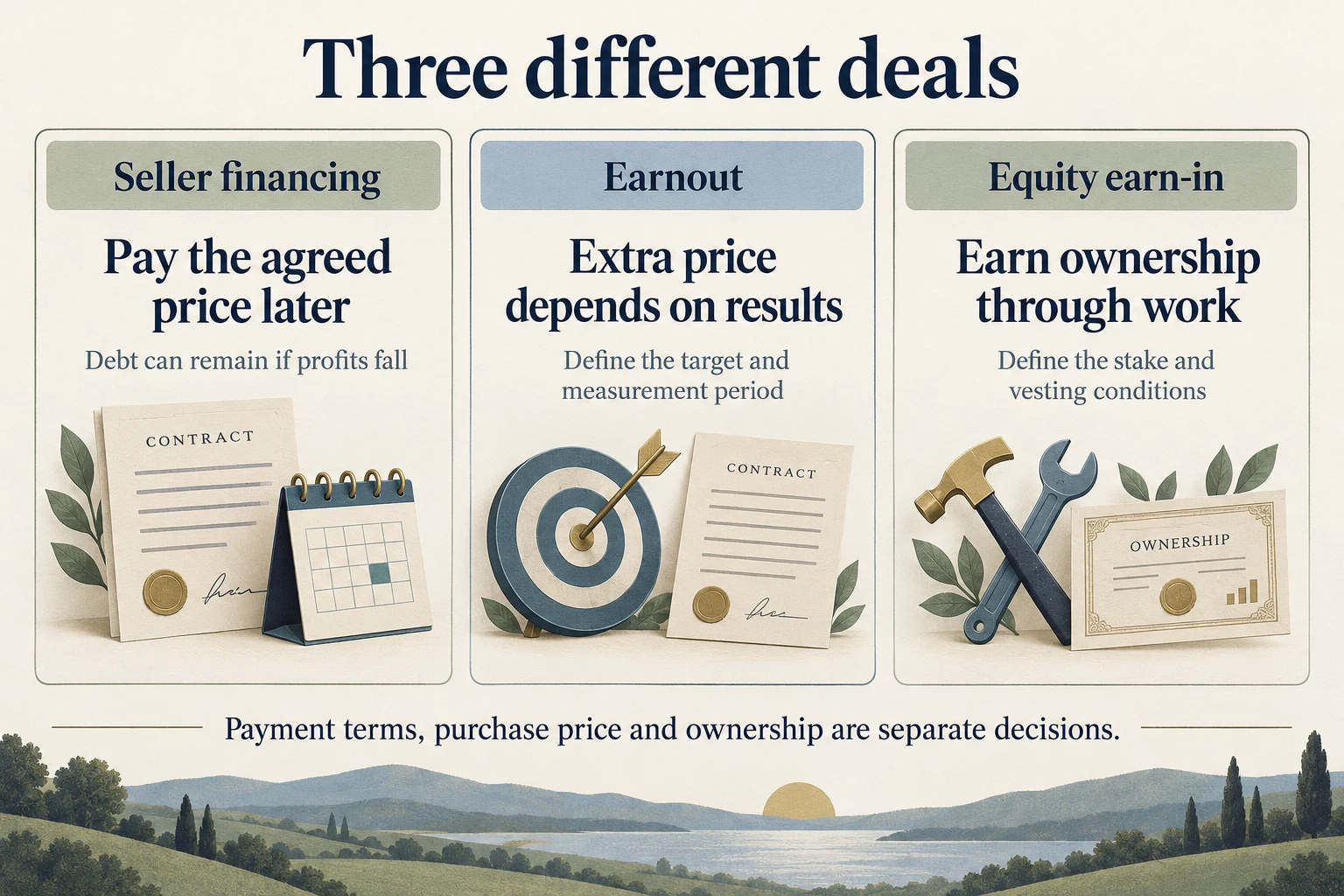
Decide separately how the price is determined, when money is paid and when ownership changes.
An earnout makes part of the acquisition price depend on performance after closing. A buyer might agree to $12,000 plus another $5,000 if the app meets a defined profit target over an agreed period. The additional amount is conditional. A fixed seller note generally remains an obligation even if the app performs poorly. McCormick Law & Consulting explains this distinction and the potential for disputes when the buyer controls expenses that affect an earnout. Seller notes and earnouts
Sweat equity, or an equity earn-in, gives someone ownership for contributing work. A developer or growth operator might earn a minority stake after delivering agreed milestones. The ownership instrument, percentage and vesting conditions must actually be documented. CFI's explanation of sweat equity
An app itself doesn't issue shares. If someone offers “15% of the app,” clarify whether that means equity in an entity that owns it, a contractual share of income, or another defined interest. Those arrangements can give you different control, sale proceeds and obligations.
| Arrangement | What you receive | What it does not automatically provide |
|---|---|---|
| Performance fee | Compensation for an agreed result | Ownership or a right to buy |
| Purchase credit | An agreed reduction in a future purchase price | Shares or a completed acquisition |
| Purchase option | A right to buy specified assets or shares on agreed terms | Funding for the purchase |
| Equity earn-in | Ownership as the agreed conditions are met | Control, a salary or guaranteed distributions |
For a buyer with little capital, these distinctions help identify the actual gap. A profit share can pay for your work. A purchase option can protect a future opportunity. Neither funds the remaining price unless the deal includes a way to pay it.
Start with an operating agreement and a purchase option
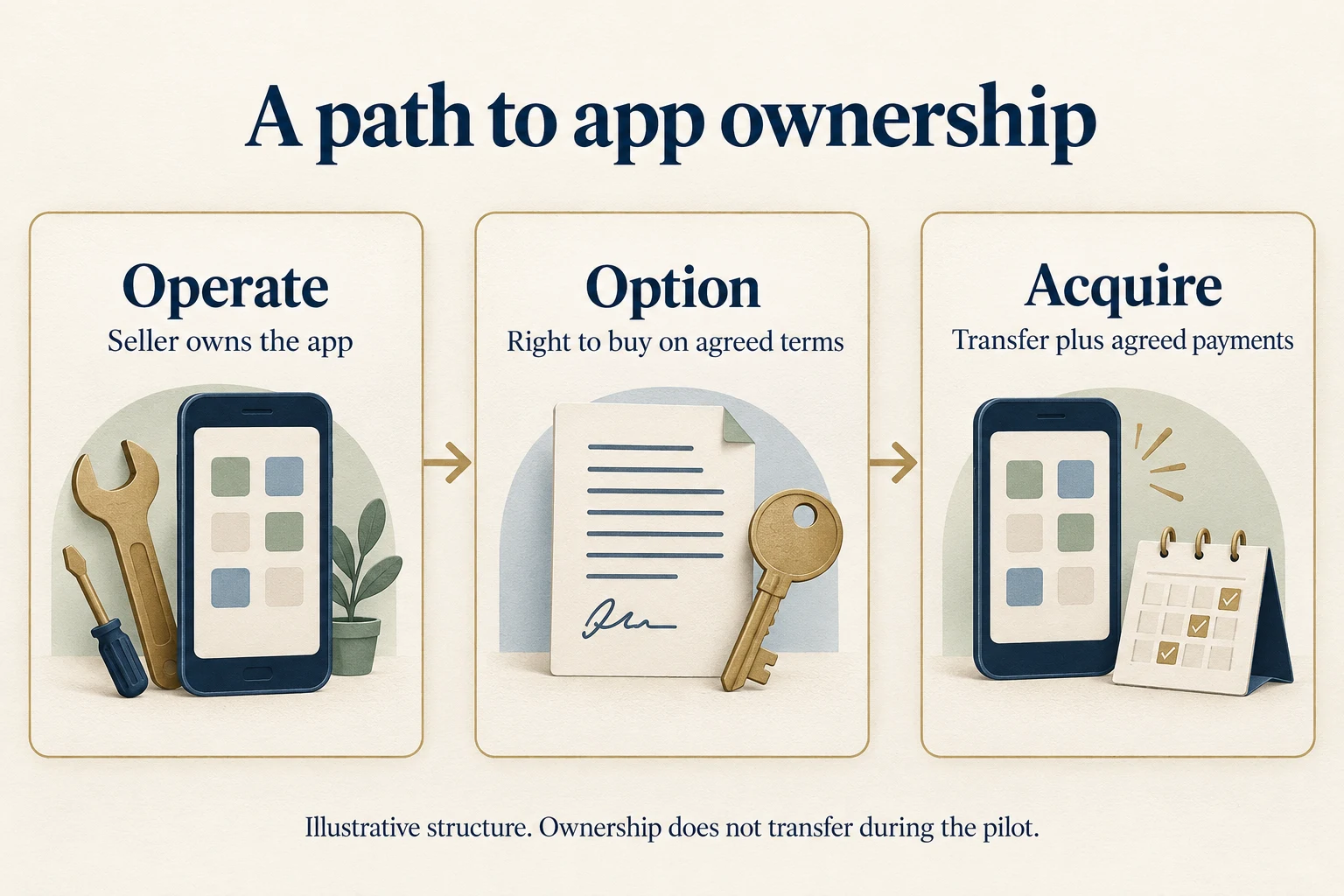
Agree the option before substantial work begins. The diagram shows the path to ownership, not the order in which contracts should be negotiated.
A short operating trial can help both sides decide whether a sale makes sense. You learn how the app works and whether your proposed improvements are practical. The owner sees whether you deliver, communicate and respect spending limits.
Here is one possible structure for discussion. These are proposed terms, not market-standard percentages or a promise that an owner will accept them.
Define a bounded operating trial
Set a 90-day period with a specific scope: improve the first-use experience, test store screenshots, or build useful content around a conversion task. Commit to work you can personally perform. Name the person responsible for releases, outages and support.
The owner retains the app during the trial and funds agreed operating costs. Your compensation could be 35% of incremental profit above a verified baseline. Define access permissions and a spending cap so the owner knows which decisions require approval.
If a release is necessary, agree who will build it and when. A growth plan that depends on a developer who has no available time is unlikely to produce a useful trial.
Establish the profit baseline
Reconcile several recent months of proceeds and expenses, then examine seasonality, unusual promotions and the owner's workload. A recent revenue peak shouldn't become the baseline by accident. Neither should an unusually weak month chosen to make improvement look easy.
For this example, define profit as store proceeds after fees and refunds, less agreed operating costs, before the operator's performance fee and income tax. Specify treatment of paid acquisition, API usage, maintenance and shared costs. Already-net proceeds should not lose another store commission in the spreadsheet.
Agree what happens when spend produces receipts later. A simple monthly comparison can reward one person for an earlier campaign or charge them for investment whose benefit arrives after the trial. Review results across the full period and include an agreed reconciliation for delayed refunds and receipts.
Set the purchase terms before improving the business
A purchase option needs a defined subject, price or pricing formula, exercise period and conditions. Consider the actual grant in this example purchase-option clause: the right to buy is distinct from an obligation to buy. Your documents must fit your transaction rather than copy an unrelated clause.
For a small app, the parties could discuss a six-month option at a price supported by pre-trial financials. That gives the operator a reason to invest time without having the price reset solely because their work succeeds. The owner may want milestones, a shorter period or compensation for granting that right.
Negotiate financing alongside the option. If the balance must be paid entirely in cash, a buyer with no funding may finish a successful trial and still be unable to exercise it. Also address earned credits if the arrangement ends or the owner sells to someone else.
A worked example: profit share and purchase credits
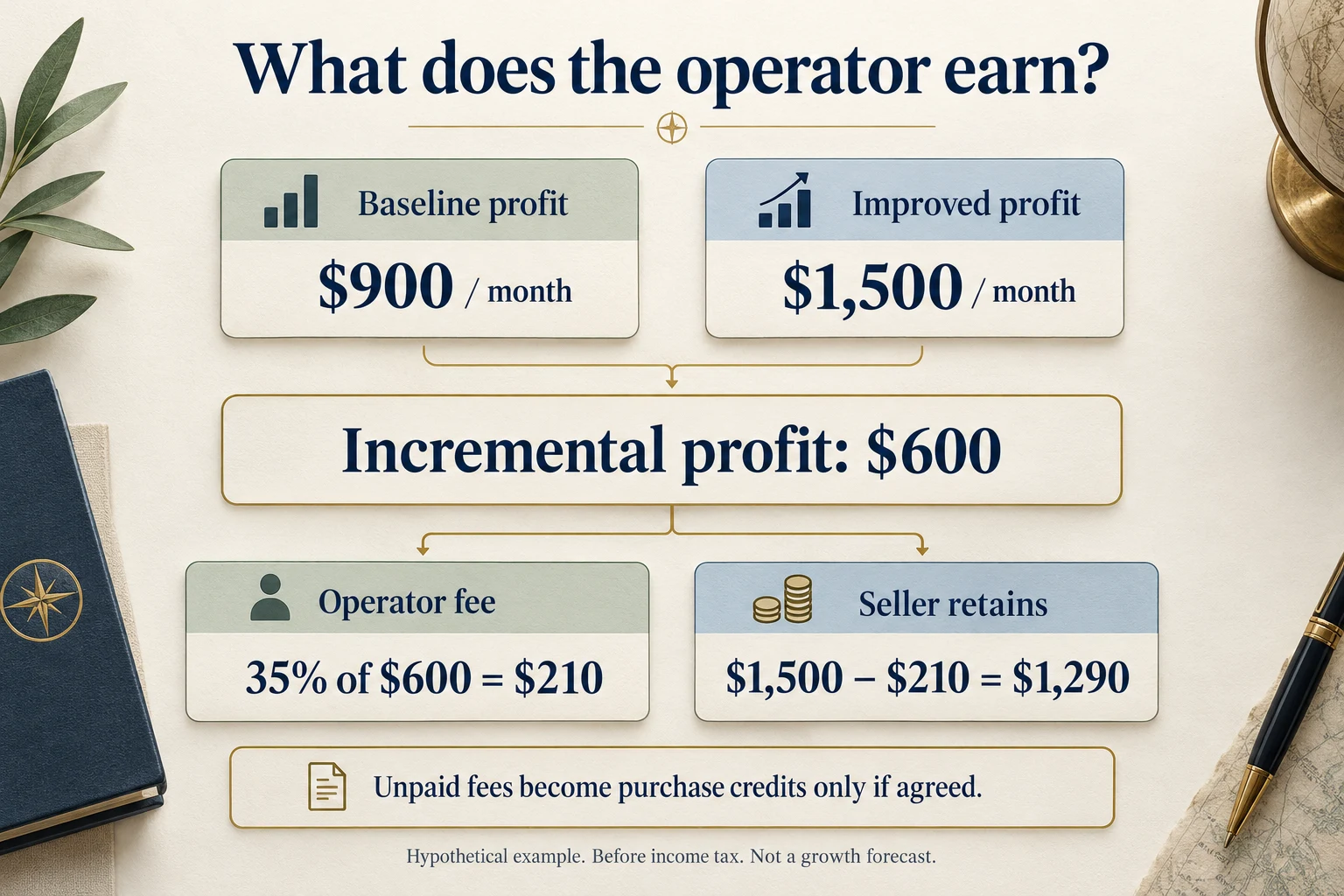
Assume a hypothetical utility app has $900 in verified monthly profit under the agreed definition. After changes, one month's profit reaches $1,500. This is an illustration of the calculation, not a forecast.
| Monthly calculation | Amount |
|---|---|
| Profit before operator fee | $1,500 |
| Agreed baseline | −$900 |
| Incremental profit | $600 |
| Operator fee: 35% of the increment | $210 |
| Profit remaining for the seller after that fee | $1,290 |
The seller receives $390 more than the baseline after paying the fee. The operator earns $210 for the period. If the agreement allows it, the operator can waive that cash payment and receive a $210 credit against the purchase price instead. The seller's current cash and the eventual amount due then differ from the cash-fee case above.
A paid fee cannot also become a purchase credit. Keep a ledger showing what was earned, paid, disputed and credited.
Credits alone can be slow. Three months at $210 would accumulate $630. Against a hypothetical $15,000 price, that leaves $14,370 to finance. At the same rate, credits alone would take about six years to cover the whole price. The calculation is a reason to agree the financing early, rather than assume the work will quickly buy the business.
Can the app afford the repayments?
After acquisition, the performance arrangement would end or be explicitly replaced. You now operate the business as its owner and meet the purchase obligations. Avoid a model that quietly counts both the old operator fee and the full cash balance as available for repayment.
Model cash available for acquisition payments separately from reported profit. Start with cash collected, pay necessary operating expenses, and allow for working capital, tax obligations, agreed owner compensation and reserves. A payout delay or an annual subscriber's future service costs can make cash less available than a monthly profit number suggests.
Suppose a separate hypothetical deal has a $15,000 financed balance. A negotiated cash-sweep arrangement allocates 60% of the defined available cash to the seller. A cash sweep means allocating an agreed share of cash to repayment; it does not itself make the debt contingent.
| Monthly cash available before the sweep | Seller payment at 60% | Cash remaining after payment | Payment months to clear $15,000 |
|---|---|---|---|
| $600 | $360 | $240 | 42 |
| $1,000 | $600 | $400 | 25 |
| $1,500 | $900 | $600 | 17 |
These are arithmetic scenarios with unchanged monthly cash, no interest and a smaller final payment where needed. They are not repayment quotes. The balance is before any pilot credits. Real note terms may include interest, minimum payments and a fixed maturity, which change the result.
Run a weaker case before negotiating: receipts fall, the API bill rises, or you need a contractor for maintenance. If the deal requires immediate growth to avoid missing payments, reconsider the price, payment structure or acquisition itself. The app valuation calculator can help test the earnings assumptions, but its valuation output is not a financing approval.
What happens if the app stops making money?
“We'll pay from cash flow” leaves a critical question unanswered: what happens to the outstanding balance when there is no cash?
A fixed debt may remain due even when payments are calculated using profit. An earnout can make a defined payment conditional. A guarantee or security arrangement affects the seller's recourse. Ask counsel to make those consequences explicit. How seller-note protections work
For your proposed deal, put four scenarios in writing: a weak month, a prolonged decline, a sale to another buyer, and an app that must shut down. State whether each causes a payment deferral, a recalculation, a default or some other agreed outcome. Define what remains payable at maturity rather than leaving an unaffordable balloon payment hidden in the schedule.
These terms protect both sides. The seller needs visibility into the business and agreed limits on decisions that could divert cash. The operator needs enough freedom to maintain and improve the product. A seller may reject limited recourse or variable payments; willingness to finance does not imply willingness to absorb every business risk.
Give the seller a reason to choose you
A seller considering this proposal is assessing your ability to run the app and pay them. Explain the specific work you will take over, the evidence behind your first experiment and the time you can commit. A short audit or a relevant operating result is more useful than a promise to double revenue.
Their reason to sell matters. Someone who wants fewer support duties may value a dependable operator. Someone who needs cash immediately may be a poor fit for a fully deferred purchase. If a comparable cash offer is available, your proposal must compensate for delay and risk.
The parties might negotiate interest, a higher deferred price, a retained stake or a conditional additional payment. Compare each structure's total obligations and timing. An $18,000 deferred offer is not economically identical to $15,000 paid today, and neither is automatically better for both parties.
You could begin the conversation like this:
I'm interested in operating and eventually acquiring the app. My initial focus would be improving the first successful conversion and testing store pages around the strongest customer use cases.
I'd like to discuss a 90-day operating trial with compensation tied to incremental profit. You would retain ownership and fund agreed operating costs during the trial. Before work starts, we would agree a purchase option, how any unpaid fees become purchase credits, and whether you would finance the remaining balance.
If that structure is of interest, the next step would be to review the current financials, your asking price and the responsibilities you want to hand over.
Tailor the work to the actual app. Do not offer development, support or paid acquisition you cannot deliver or fund.
Keep the handover separate from the payment promise
Financing does not transfer a repository, separate a shared backend or establish ownership of third-party assets. Build an inventory of the code, domain, designs, store listing, accounts, licenses and data rights, with a responsible person and an acceptance check for each.
Apple allows eligible apps to transfer while retaining ratings and reviews. Its documentation also says the parties exchange the code and build assets directly; store transfer is only one part of the handover. Subscription and other service configurations can require additional preparation. Apple's app transfer overview
The next useful document is a short proposed term sheet covering the assets, operating trial, price, funding, payment terms and exit scenarios. Take that and the reconciled financials to your advisers before turning the proposal into binding documents. If the app's existing earnings cannot support the arrangement, a narrower paid operating role may be a better starting point than ownership.
If you own an app and want to explore these options with us, discuss selling your app or partnering with NaviStack. We can consider an acquisition, seller financing or an operating partnership, subject to fit, due diligence and agreed terms.
Keep reading
More practical guides and comparisons selected for this topic.