AI rollups: how to buy a business and improve it with AI
Learn how AI rollups work, what buying a business with 20% down really costs, and how the buy-and-improve approach applies to mobile app portfolios.

Research method and disclosure
An editorial explainer based on four YouTube interviews and explainers, official company announcements, OpenAI’s engineering case study, McKinsey research, SBA lending documentation, and Apple’s search and app-maintenance guidance checked on October 1, 2026. Financial scenarios are hypothetical. NaviStack has not completed the acquisitions discussed or independently audited their operating results. Financing eligibility and terms require lender review. Illustrations and infographics are AI-generated; their numerical examples are also explained in accessible text and tables.
NaviStack offers AI integration and marketing services. The closing section invites inquiries about those services.
An AI rollup starts with a business that already has customers. You buy it, improve how it delivers its service, and eventually repeat that process with similar businesses. AI is part of the operating plan: handling repetitive work, helping staff serve more customers, or reducing costs that would otherwise grow with revenue.
That makes the idea relevant beyond venture funds. A smaller buyer can start with one profitable business, use acquisition financing, and introduce AI where the numbers support it. The hard part is choosing a business you can run and a purchase you can afford before those improvements arrive.
TL;DR
| Your question | Short answer |
|---|---|
| What is an AI rollup? | Acquiring similar businesses and using shared AI tools and operating processes to improve them. |
| Can a smaller buyer start? | Yes, with one acquisition, enough capital, relevant operating skills, and a financing plan a lender will accept. |
| Does 20% down cover everything? | It can describe your share of the purchase price. Fees, working capital, and implementation may require more cash. |
| How does AI create profit? | Through real cost reductions or additional profitable sales, after software, integration, and review costs. |
| Where do mobile apps fit? | App portfolios share the buy-and-improve logic, but retention, code ownership, and platform dependencies change the diligence. |
What is an AI rollup?
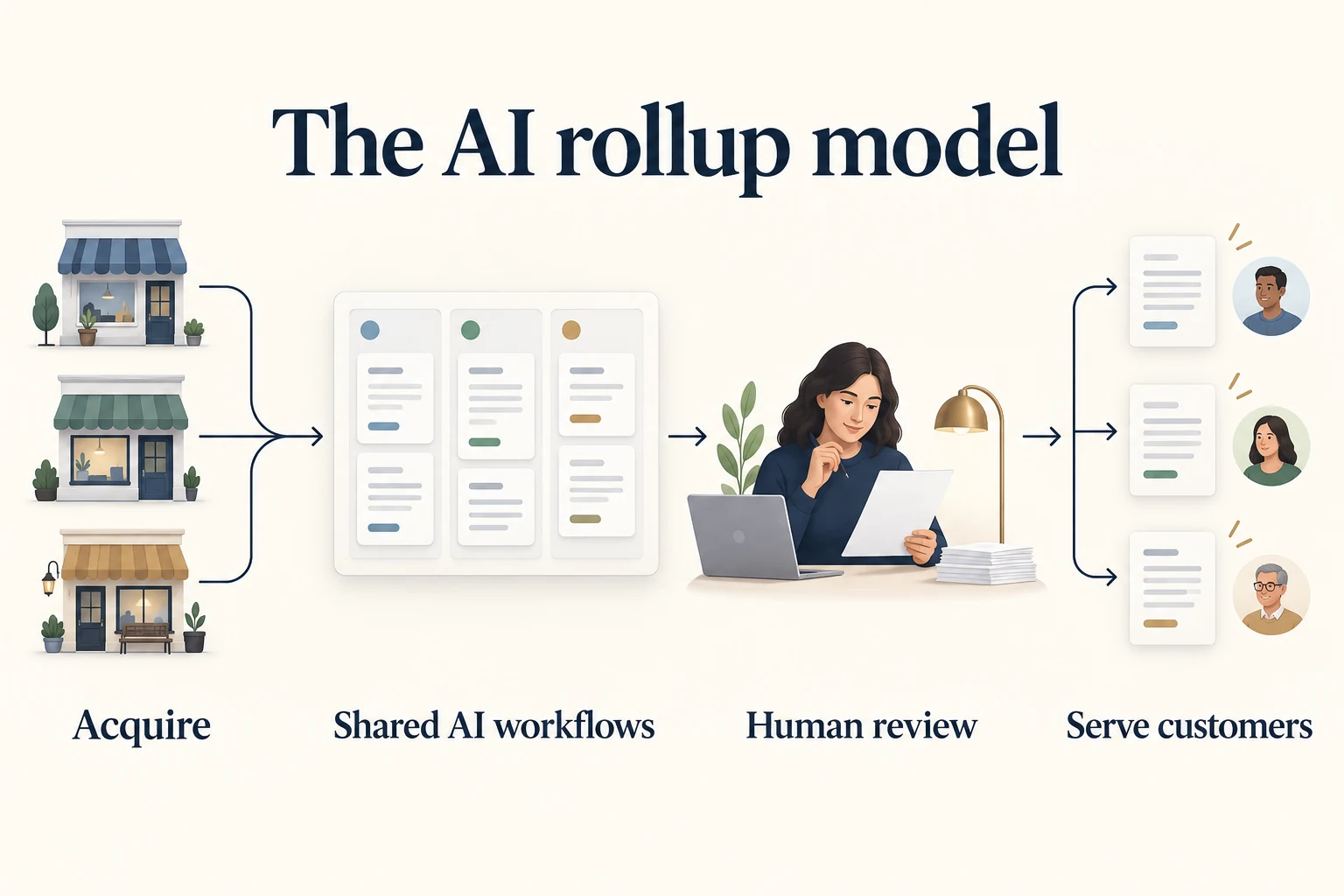
The operating business and the technology share an owner. Human review remains part of delivering the service.
A rollup combines several businesses under common ownership. An AI rollup adds a specific thesis: shared technology can improve the economics of delivering the service across those businesses.
Consider several accounting practices. Each has client relationships, recurring work, and its own way of collecting documents and preparing returns. An acquirer might introduce a common intake process, automate parts of document extraction, and give accountants more time for review and client advice. If that process works, the next acquired practice can use parts of the same system.
The buyer owns both the customer relationship and the operating business. That gives them more authority to change workflows than a software vendor selling another subscription. It also makes them responsible for payroll, service quality, complaints, and every promise made to those customers.
One acquisition is a starting point, rather than a rollup by itself. Buying and running an existing business is often called entrepreneurship through acquisition, or ETA. A buyer can stop there and build a valuable business without assembling a portfolio.
Here, “rollup” means business acquisitions. The term also appears in blockchain discussions, which describe a different technology.
Why AI rollups are getting attention
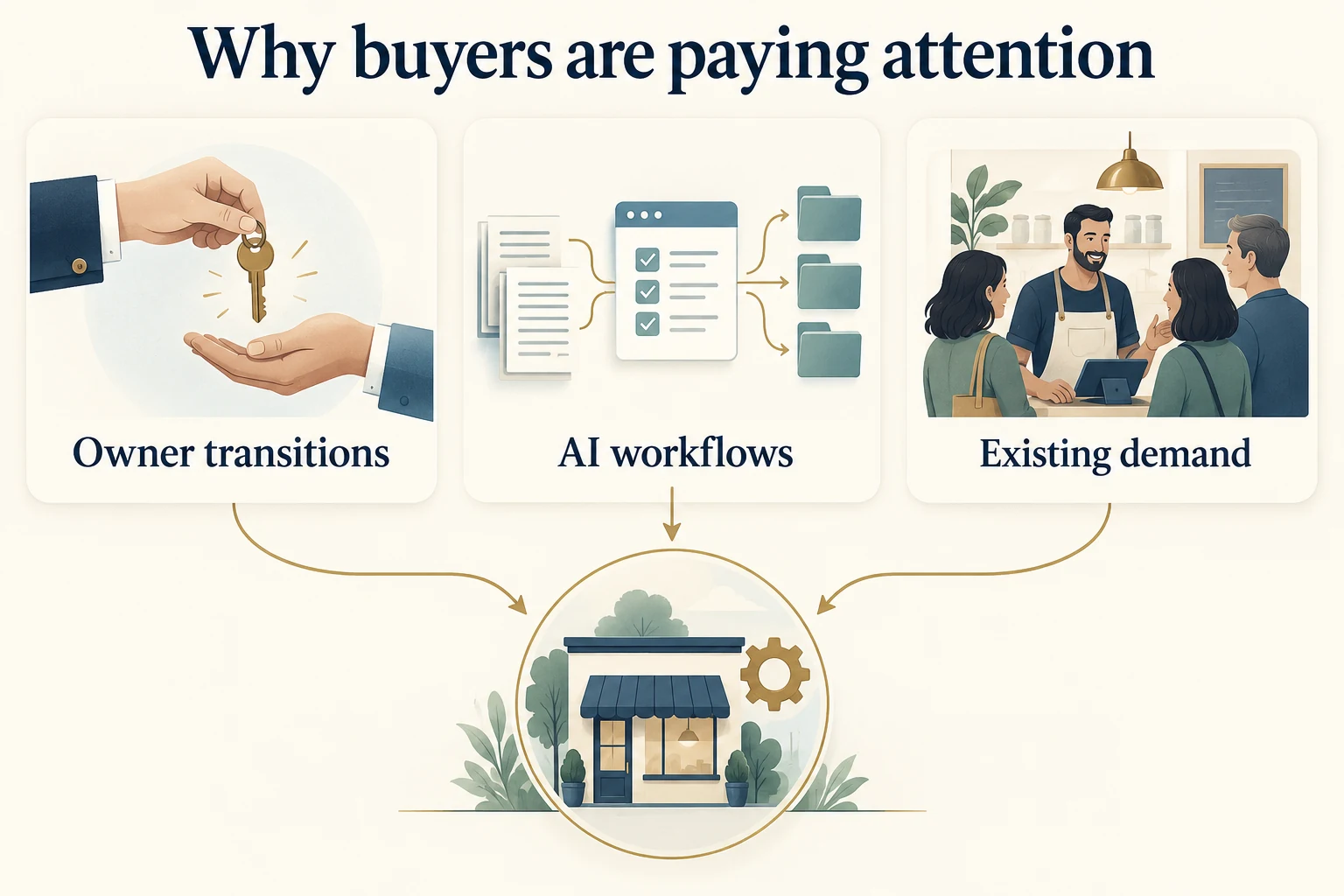
These factors explain the interest in the model; they do not establish the return on a particular acquisition.
The four interviews and explainers behind this article approach the opportunity from different directions. Greg Isenberg connects business succession with improving AI capabilities. Joe Schmidt at a16z explains why owning a service business can make it easier to implement technology. Cabana founder Jeremy Yamaguchi brings the discussion back to buying companies and running field operations. General Catalyst’s Marc Bhargava describes a model built around software pilots, acquisitions, and further investment.
There is a substantial succession opportunity. McKinsey projects that more than one million viable US small and medium businesses could be candidates for a sale or employee ownership by 2035, representing up to $5 trillion in enterprise value. That is an estimate of potential ownership transfers, not a forecast of AI profits. McKinsey’s ownership-transfer research
There are also documented acquisitions behind the thesis. Crescendo announced its acquisition of customer-support provider PartnerHero in October 2024. General Catalyst describes Titan’s acquisition of IT services company RFA and Eudia’s acquisition of legal services company Johnson Hana. These deals show companies combining technology with existing service delivery. They do not establish a standard return for the next buyer. Crescendo’s acquisition announcement, General Catalyst’s services thesis
A more useful operating example comes from Thrive Holdings and OpenAI. In May 2026, their engineering teams reported that Tax AI processed 7,000 returns across participating Crete firms and saved practitioners about a third of their preparation time. Practitioners still reviewed the work and approved final filings. The system captured corrections so engineers could improve recurring failures. These are results reported by the teams that built it, rather than an independent audit of acquisition returns. OpenAI’s Tax AI case study
For a buyer, the useful evidence is a particular workflow, a measurable improvement, and a person responsible for the final result. A claim that an entire industry will suddenly earn software margins tells you much less about the business you're considering.
How an AI rollup is done
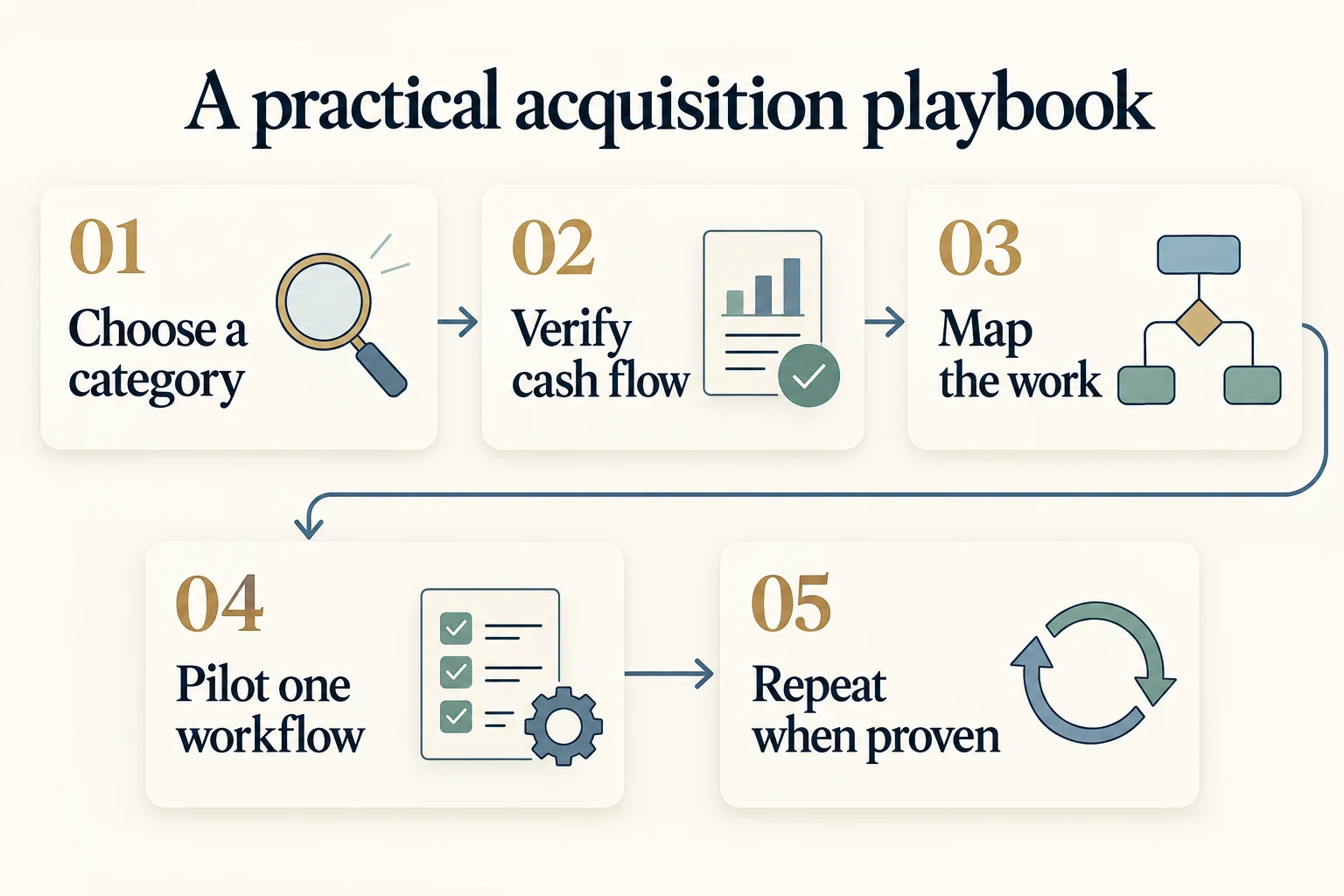
Prove the economics and the operating process before adding another business.
There are two credible starting sequences. A team can develop technology with pilot customers, prove that it improves a workflow, and then acquire a business where it can deploy the system. General Catalyst describes that approach in the Sourcery interview.
A buyer can also acquire a sound business first, learn its operations, and build around the problems they find. Yamaguchi describes that sequence at Cabana: proving that the company could acquire pool-service businesses was an early priority, while operating the acquired companies informed the software it needed.
The choice depends on what you know and what you still need to prove. A software team with no operating experience has a different problem from a pool-service operator who already understands customers, routing, and staffing. Both need a business that works financially.
1. Choose a narrow business category
Start with businesses whose customers, workflows, and economics you can understand. Useful characteristics include repeat demand, dependable collections, similar administrative tasks, and a manager or team capable of maintaining service through a transition.
A physical service can still benefit from AI. A pool-service company needs technicians to visit pools, but quoting, scheduling, customer messages, and billing may offer opportunities. The value depends on the actual bottleneck: faster quoting matters if slow quotes are losing sales; it matters less if the company already has more work than it can staff.
Look for weaknesses that have a plausible remedy. Missing invoices and repetitive data entry are different from customers leaving because the service is poor. AI may help diagnose the second problem, but buying software alone won't repair it.
2. Underwrite the business as it operates today
Ask whether the acquisition works if AI produces no financial improvement in the first year. A deal that needs immediate automation savings to make its loan payments leaves little room to learn.
Compare the seller’s financial statements with tax returns, bank deposits, payroll, and customer records. Check customer concentration, renewals, outstanding receivables, seasonality, employee turnover, and the seller’s role in winning and retaining work. Confirm which contracts, licenses, systems, and intellectual property can transfer.
Pay particular attention to the profit measure. Seller’s discretionary earnings may add back one owner’s compensation and certain expenses. EBITDA excludes interest, taxes, depreciation, and amortization. Neither automatically tells you what cash will remain after hiring a replacement operator, maintaining equipment, funding working capital, and repaying acquisition debt.
If the seller handles sales, staff management, and delivery, put a realistic replacement cost into your model. You can do some of that work yourself, but then part of your return pays for your labor.
Find potential sellers through business brokers, industry contacts, and direct conversations with owners in your chosen category. Screen several businesses against the same criteria, and get an early lender assessment before spending heavily on one target. An owner’s willingness to sell does not establish that the business is financeable.
When a target survives that screen, use accounting and legal help to investigate it and document the transaction. Agree how diligence, financing approval, asset and contract transfers, working capital, and seller training affect closing. The handover plan deserves the same attention as the purchase price: somebody must keep answering customers while ownership changes.
3. Map the work before changing it
Follow a customer from first inquiry to payment. Find where staff retype information, wait for documents, correct mistakes, or pass work between disconnected systems.
Choose one workflow with enough volume to measure and a manageable consequence if the system gets it wrong. Preparing an internal draft or flagging an incomplete file can be a better starting point than automatically sending a final client deliverable.
Use existing software where it meets the need. Building a proprietary platform adds engineering and maintenance costs. Cabana’s case for custom software rests on its particular operating requirements; it is not a reason every buyer needs an engineering team.
4. Prove the improvement in live operations
Run the new process alongside the existing one first. Measure completion time, accuracy, corrections, and the total cost of getting an acceptable result. Include staff review time.
Keep human approval for consequential actions, such as a regulated filing, a payment, or a contractual commitment. Confirm that your use of customer data fits contracts, privacy requirements, and the AI provider’s terms before connecting production systems.
Bring employees into the design. They know the exceptions that a process diagram misses. Record their corrections, turn repeated failures into test cases, and check that a change fixes those cases without breaking previously accepted work.
5. Acquire the next business when you can repeat the process
A second acquisition adds another transition, another set of records, and potentially another operating culture. Similar services help, but they don't guarantee compatible systems or customers.
Before expanding, you should be able to explain the first business’s performance with evidence: customer retention, cash collected, service quality, implementation costs, and the financial effect of the new workflow. Keep adequate reserves rather than treating every dollar of extra cash as acquisition money.
The shared system becomes valuable when it reduces the work and cost of improving the next business. If every integration needs a new team and a full rebuild, the portfolio may be growing faster than its operating capability.
Can you buy a business with 20% down?
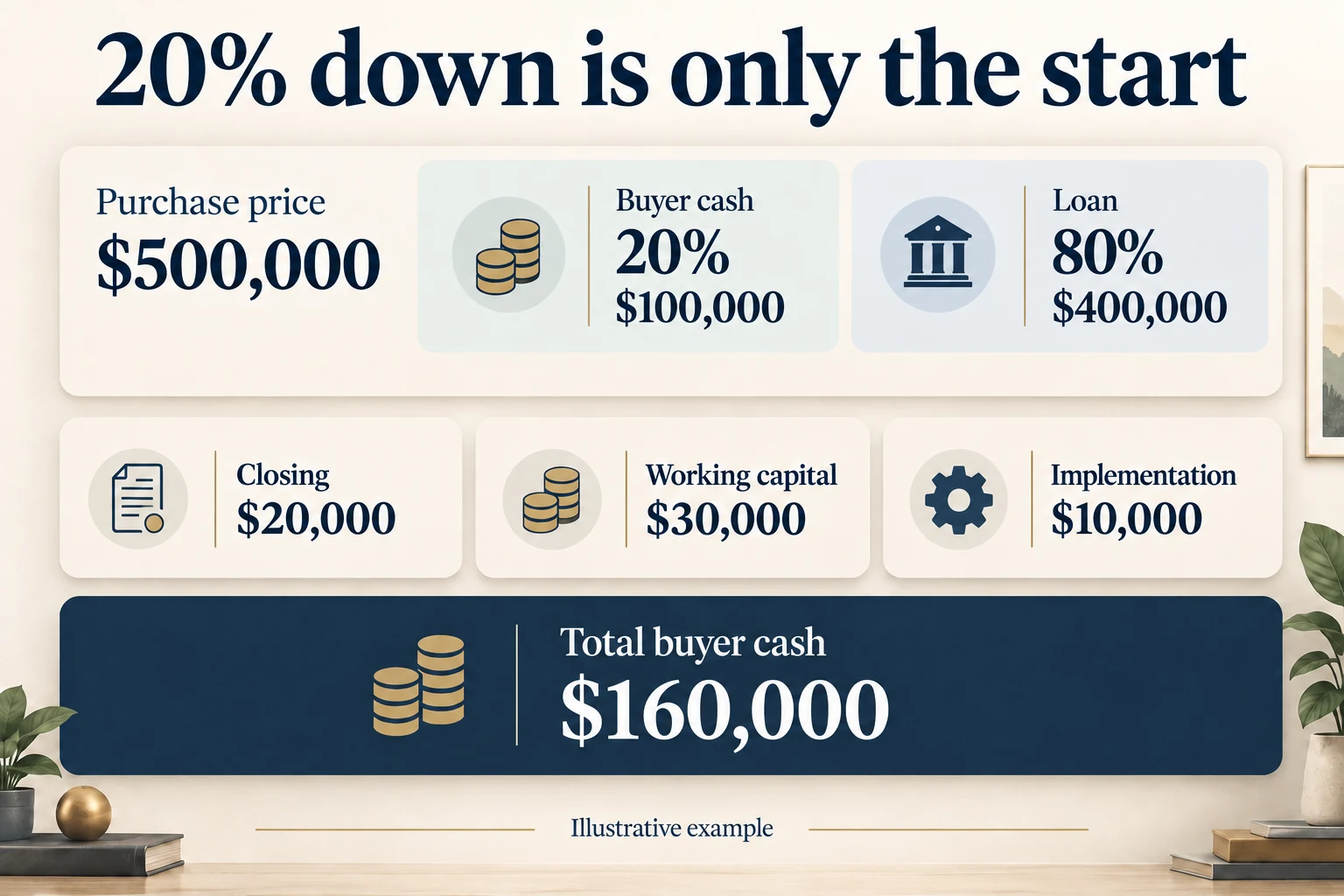
Illustrative funding, not a loan offer: 20% of the purchase price becomes $160,000 in total buyer cash in this example.
A 20% buyer contribution and 80% outside financing is a possible deal structure. It is not an automatic offer available on every business, and the purchase price is only part of the capital requirement.
Outside funding can come from a bank loan, a seller note, or investors. Those sources have different consequences. A loan creates repayment obligations. Seller financing means the seller agrees to receive part of the price later. Investor equity gives someone else ownership and rights to future returns. A seller who keeps shares has rolled over equity; that is different from lending you money.
In the US, an eligible buyer may use an SBA-backed 7(a) loan for a change of ownership. A participating lender makes the loan, and the SBA guarantees part of it. The program allows loans of up to $5 million, subject to eligibility and repayment requirements. SBA’s 7(a) program
The SBA operating procedure effective October 1, 2026 sets a minimum 10% equity injection for an initial acquisition, based on total project cost, and a 1.25:1 historical debt-service coverage requirement. Lenders can require more equity. A seller note counts toward the required injection only under specified conditions, including full standby for the loan term, and limited sources can cover no more than half of that injection. A typical individual owner with at least 20% ownership must provide an unlimited personal guarantee. That ownership threshold is separate from the down payment. Current SBA lending procedure
Ask a lender to assess the target, your operating plan, the sources of your contribution, and the entire project budget before you rely on a financing percentage. Buyers outside the US need financing that fits their own jurisdiction; SBA rules do not apply internationally.
A worked example: a $500,000 acquisition
The following numbers are hypothetical. The interest rate is an assumption, not a current loan quote.
| Purchase funding | Amount |
|---|---|
| Business purchase price | $500,000 |
| Buyer’s contribution to the price: 20% | $100,000 |
| Acquisition loan: 80% | $400,000 |
Now budget another $20,000 for diligence and closing, $30,000 for working capital, and $10,000 for initial AI implementation. Assume the buyer funds those amounts in cash. The initial cash requirement becomes $160,000, even though the buyer put down 20% of the purchase price. Actual costs and financeable expenses vary by transaction.
Suppose the $400,000 loan amortizes over ten years at a fixed 10% annual rate, with monthly payments and no additional financed fees. Payments would be about $5,286 a month, or $63,432 a year.
Assume the business produces $120,000 of annual cash available before acquisition debt service and income taxes, after paying a replacement operator, normal maintenance spending, and normal working-capital needs. This is a simplified cash-flow assumption, not the seller’s EBITDA.
| Annual scenario | Existing operation | AI improvement achieved | Downside case |
|---|---|---|---|
| Cash available before acquisition debt and income taxes | $120,000 | $138,000 | $80,000 |
| Acquisition loan payments | $63,432 | $63,432 | $63,432 |
| Cash remaining before income taxes and additional reserves | $56,568 | $74,568 | $16,568 |
In the improved scenario, assume an AI workflow creates $30,000 in annual financial benefit and costs $12,000 a year in software, support, and review. Its net contribution is $18,000. The initial $10,000 implementation expense is already included in the buyer’s starting budget; the ongoing costs belong in the operating model.
The downside case assumes lower operating cash flow and no AI benefit. It leaves only about $16,568 before income taxes and extra reserves. At $60,000 of operating cash flow, the business would fall short of the loan payments.
These scenarios show why borrowing changes the decision. The base case has roughly 1.89 times the illustrated debt payments available; the downside has about 1.26 times. A lender’s actual coverage calculation can differ and must account for other debt and its underwriting rules. Passing a minimum coverage test does not mean the buyer has a comfortable personal income or enough cash for surprises.
How AI improvements turn into profit
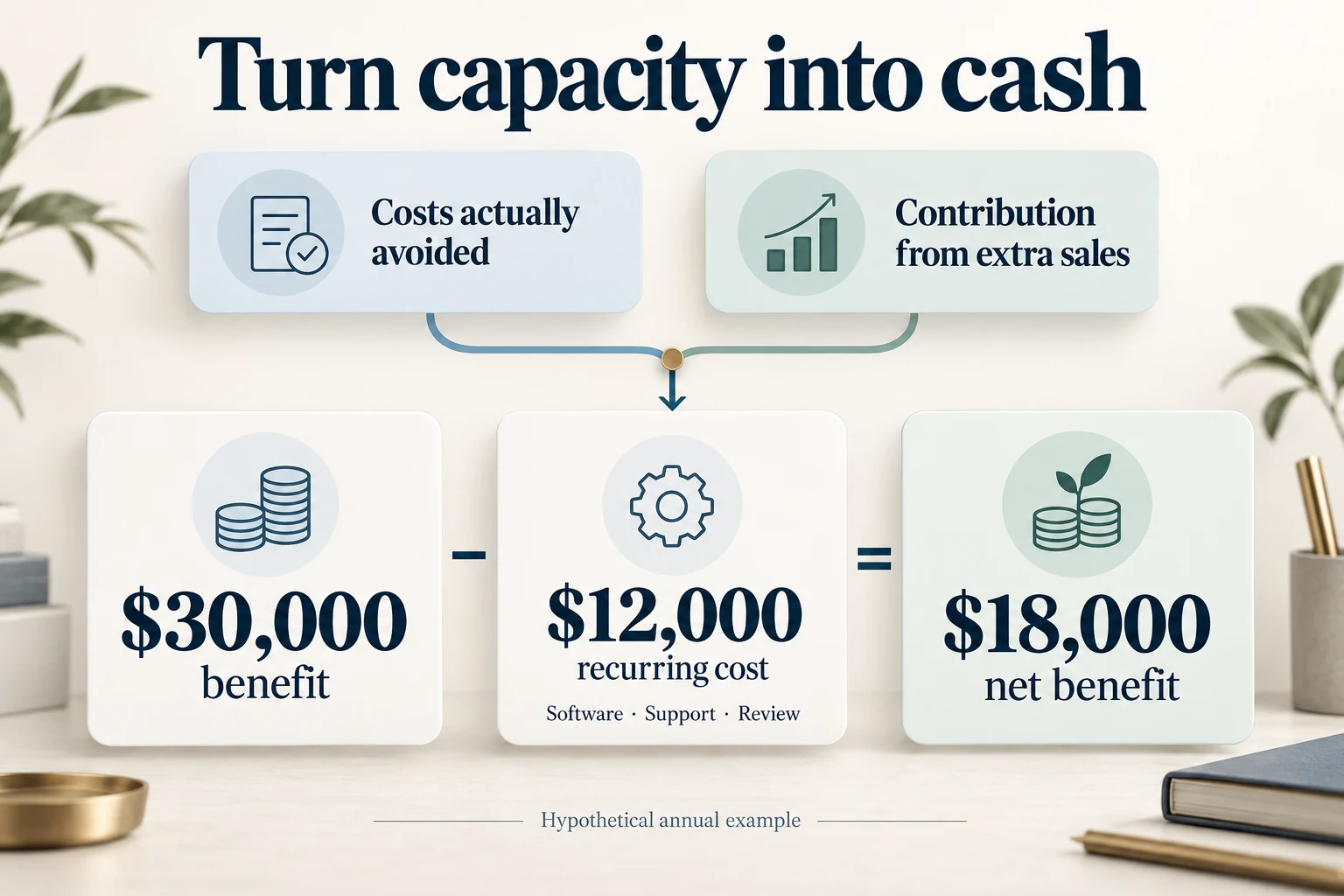
Count costs actually avoided and contribution from additional sales. Upfront implementation is budgeted separately.
Saving staff time is an operating result. Converting that time into cash takes another step.
If an employee saves five hours a week but the company pays the same salary and serves the same customers, the immediate payroll saving is zero. The time can still improve service or reduce overload. To increase profit, the business might use that capacity to serve additional paying customers, avoid an otherwise necessary hire, or reduce an expense it actually incurs.
The basic calculation is:
Net AI benefit = costs actually avoided + contribution from additional sales − software, integration, support, and review costs.
Use the contribution from extra sales, after the costs of serving them, rather than counting every new dollar of revenue as profit. Include the cost of mistakes and rework. If an AI feature adds model usage charges to every customer interaction, those charges grow with demand.
| Workflow to test | Possible economic benefit | Evidence to collect |
|---|---|---|
| Inquiry intake and quote preparation | More qualified inquiries become profitable jobs | Conversion, completed jobs, contribution per job, errors |
| Document extraction and draft preparation | More work completed without the next hire or overtime | Accepted work per person, review time, actual labor costs |
| Customer support triage | Less repetitive handling while preserving service | Cost per resolved issue, escalations, repeat contacts, retention |
| Invoice preparation and follow-up | Fewer billing omissions and faster collections | Correct invoices, overdue balances, cash collected |
Faster collection improves liquidity; it does not necessarily increase accounting profit. More drafts produced does not prove more accepted work. Choose the financial measure that matches the workflow.
A practical first 90 days
Days 1–30: keep service stable, learn from the team, and establish a baseline. Track how much work arrives, what it costs to complete, where errors occur, and when customers pay. Pick one workflow and assign an accountable operator.
Days 31–60: run a limited pilot. Compare its outputs with accepted examples, record corrections, and include review and integration costs. Keep the existing process available while you resolve failures.
Days 61–90: expand only if the results justify it. Check whether the time saved has produced an avoided expense, additional profitable work, or a service improvement customers value. If it hasn't, revise the plan before spending on more tools or another acquisition.
Where mobile app acquisitions fit
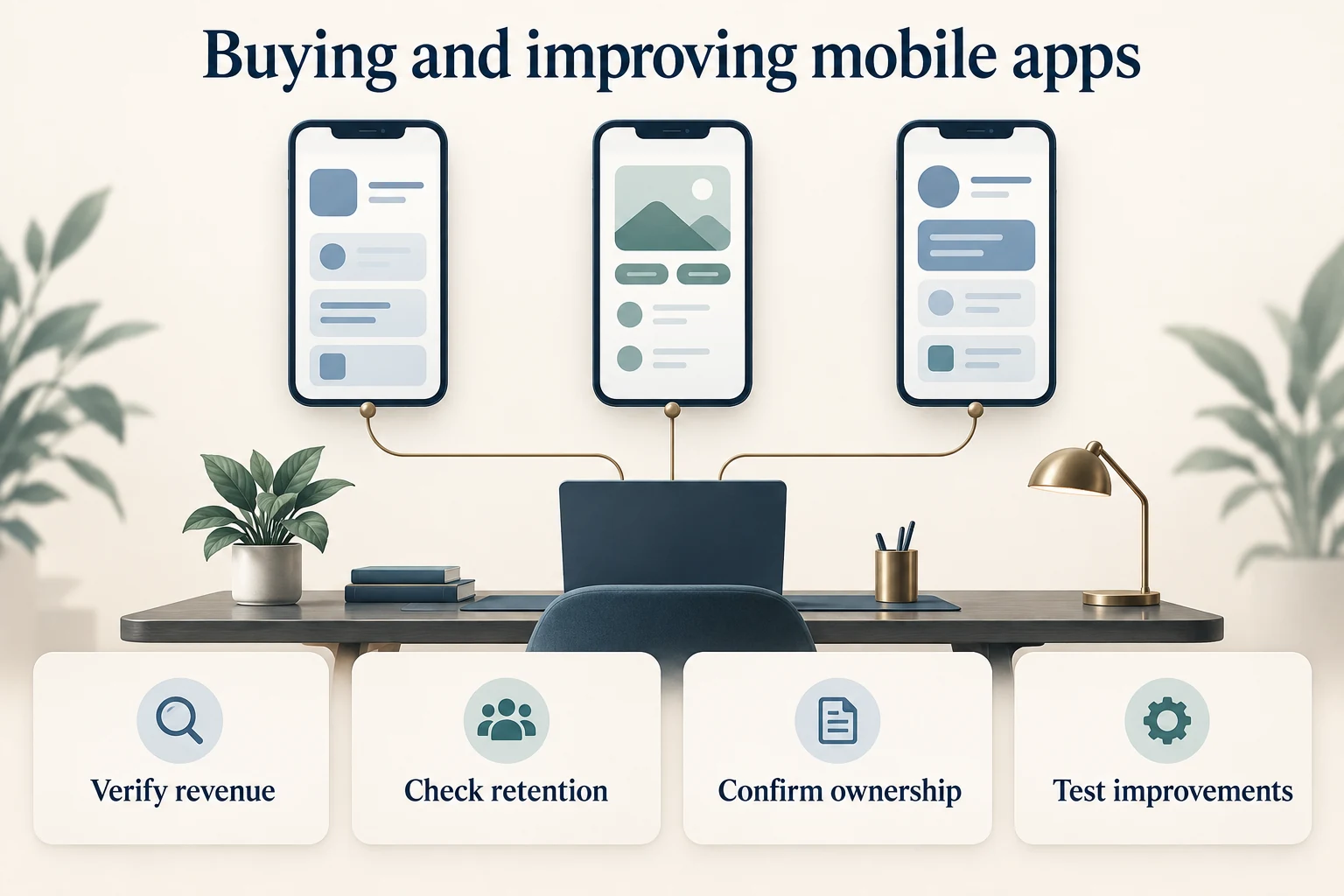
App portfolios need their own financial, technical, and transfer review.
Mobile apps offer another version of buying an existing product and improving it. An app can come with users, revenue, a codebase, and evidence of demand. A portfolio owner may share analytics, support processes, subscription expertise, or creative production across several apps.
The attraction is similar, but the assets and risks differ. App-store distribution, subscription retention, platform requirements, and software dependencies matter in ways they don't for a local service route. An AI feature can also add substantial ongoing costs to an app whose margins previously depended on inexpensive software delivery.
Buying an overlooked app with an existing ASO footprint
An app that hasn't been updated in a long time can be worth investigating if people still find it through relevant searches and keep using it. App store optimization (ASO) is the work of improving an app's visibility and conversion in the stores. An existing ASO footprint might include visibility for useful search terms, ongoing search-driven downloads, and ratings and reviews that help users assess the product.
That gives a buyer something to build on. The opportunity is to preserve the demand that already exists while fixing the product and marketing weaknesses that limit its value.
Verify that footprint before paying for it. Ask for recent store analytics, search visibility by market, download trends, retention, and revenue records. Separate searches for the app's brand from searches for the problem it solves. For iOS, compare App Store search traffic with Apple Ads activity before treating it as organic acquisition. Apple says search ranking considers metadata relevance and user behavior, and recommends monitoring impressions, conversion, and downloads in App Store Connect. A visible ranking alone doesn't establish profitable demand. Apple's App Store search guidance
Then estimate what it will take to maintain and improve the app. Check whether the code builds, dependencies still work, ownership can transfer, and the app meets current platform requirements. An old update date can reflect limited owner attention, but it can also conceal an expensive rebuild. Apple reviews outdated or nonfunctioning apps for possible removal, so continued availability needs its own check. Apple's App Store improvements policy
A useful AI stack supports the work around that asset: coding assistance for repairs with developer review, analysis of recurring complaints, drafts of localized store copy, creative variations for ad tests, and support triage. Test onboarding and monetization changes against retention and net revenue. Add an AI feature to the product when it helps users enough to justify its running costs.
For example, a utility app might still attract downloads for a specific task despite dated screenshots and confusing onboarding. A buyer could repair compatibility issues, refresh the listing, and test a clearer first-use experience before increasing marketing spend. That is a hypothetical improvement plan; whether it pays off depends on the purchase price, repair budget, and what users do after downloading.
Start with buying an app versus building one to decide whether an acquisition fits your skills and budget. Buying removes some early product work, but you inherit the existing architecture and the reasons users stay or leave.
Before making an offer, use the app acquisition due diligence guide to examine revenue, profit, retention, code ownership, and transfer risks. The app valuation calculator can help explore assumptions; its output is a planning estimate, rather than proof of what the app will sell for.
Improvements should follow the problem you find. If purchase or subscription flows need work, the subscription launch checklist helps structure validation. If the app has a viable product and needs more creative experiments, the AI UGC-style ad workflow shows a production process. It does not establish that those ads will acquire profitable users.
Buying several unrelated apps will not automatically create shared operating advantages. Look for a reason the portfolio belongs together: overlapping users, similar purchase flows, a common technical foundation, or a repeatable growth process. Assess app financing separately, too; the 20/80 example above is not a promise that a lender will fund a particular app purchase.
What can make an AI rollup fail?
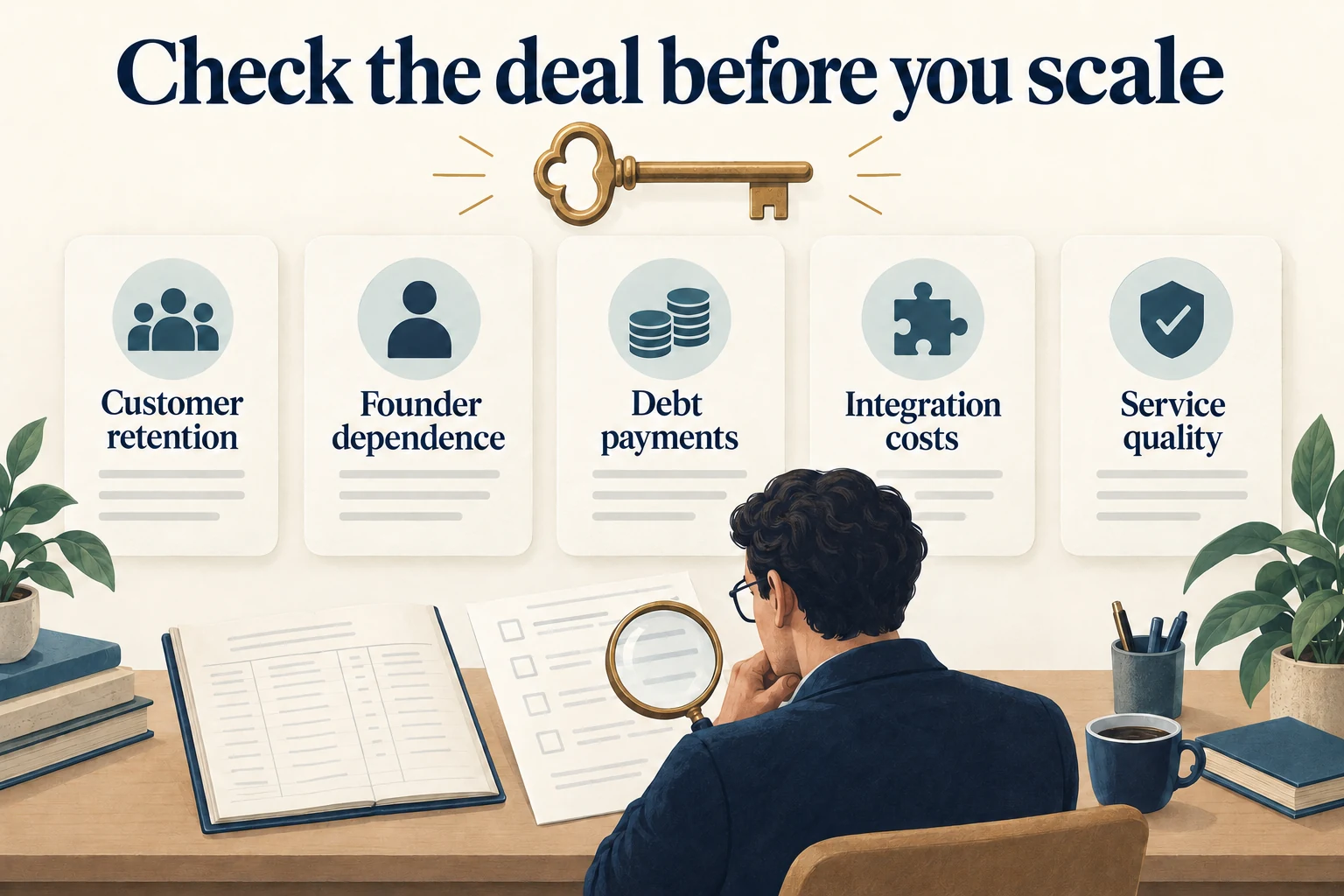
A working AI pilot cannot compensate for a deal whose customers, cash flow, or operations do not survive the handover.
The acquisition can disappoint even when the technology works. Customers may leave after the founder exits. A key employee may hold undocumented knowledge. Integration can consume the cash you expected to use for growth. Competitors may introduce the same automation and lower prices, passing some of the benefit to customers.
People also bear the consequences of the operating plan. Greater capacity may support more sales and better jobs; it can also reduce demand for particular roles. The interviews offer optimistic views of workforce expansion, but those outcomes depend on demand and management decisions. A buyer needs a clear staffing and transition plan, not a promise that automation will affect nobody.
Valuation adds another risk. A larger group might eventually command a higher sale multiple, but that outcome is uncertain. If your return depends on selling the group as a software company, check whether it still works when a future buyer values it as a service business.
For a first acquisition, put three things on one page: the cash the business produces today after paying for the work it needs, the complete funding and repayment plan, and one AI improvement you can test. If the first two are sound, you have room to learn whether the third is worth expanding.
Build your AI rollup with NaviStack
Have a business in mind—or an existing company you want to improve with AI? Bring the operating and marketing challenge to NaviStack. We help integrate AI into day-to-day company workflows, with a particular focus on marketing.
We can work with you to identify a useful first project, connect the tools to your existing processes, and define how you'll measure the result. Marketing projects can include:
- Creative production: turn customer insights into briefs, draft copy and creative variations, and keep review and ad testing organized.
- Lead handling: connect inquiries to your CRM, prepare follow-ups for approval, and give your team clear next actions.
- Measurement: bring campaign and customer data into a workflow that helps you decide what to test, improve, or stop.
For an acquired mobile app, that work can start with its existing search demand and the path from download to paying, retained user. For a service business, it can start with the path from inquiry to completed, profitable work.
Talk to NaviStack about your AI rollup. Tell us the business or app category, whether you're exploring an acquisition or already own the asset, and the workflow you want to improve. You can also email us about your project.
Keep reading
More practical guides and comparisons selected for this topic.